
The best notebooks for every kind of thought.
From reliable lined spirals to refined leather journals, this guide helps you find the right paper, format, and size for study sessions, planning, and creative work.

The right notebook changes how ideas land on the page: the right amount of space, paper that suits the tool, and a format that fits your everyday routine. Here are the details worth considering before you choose.
Quick picks
A lined spiral that does nearly everything
A spiral notebook remains an easy first choice for school, work, and planning: pages lay flat, the format is forgiving, and lined paper suits most writing-heavy tasks.
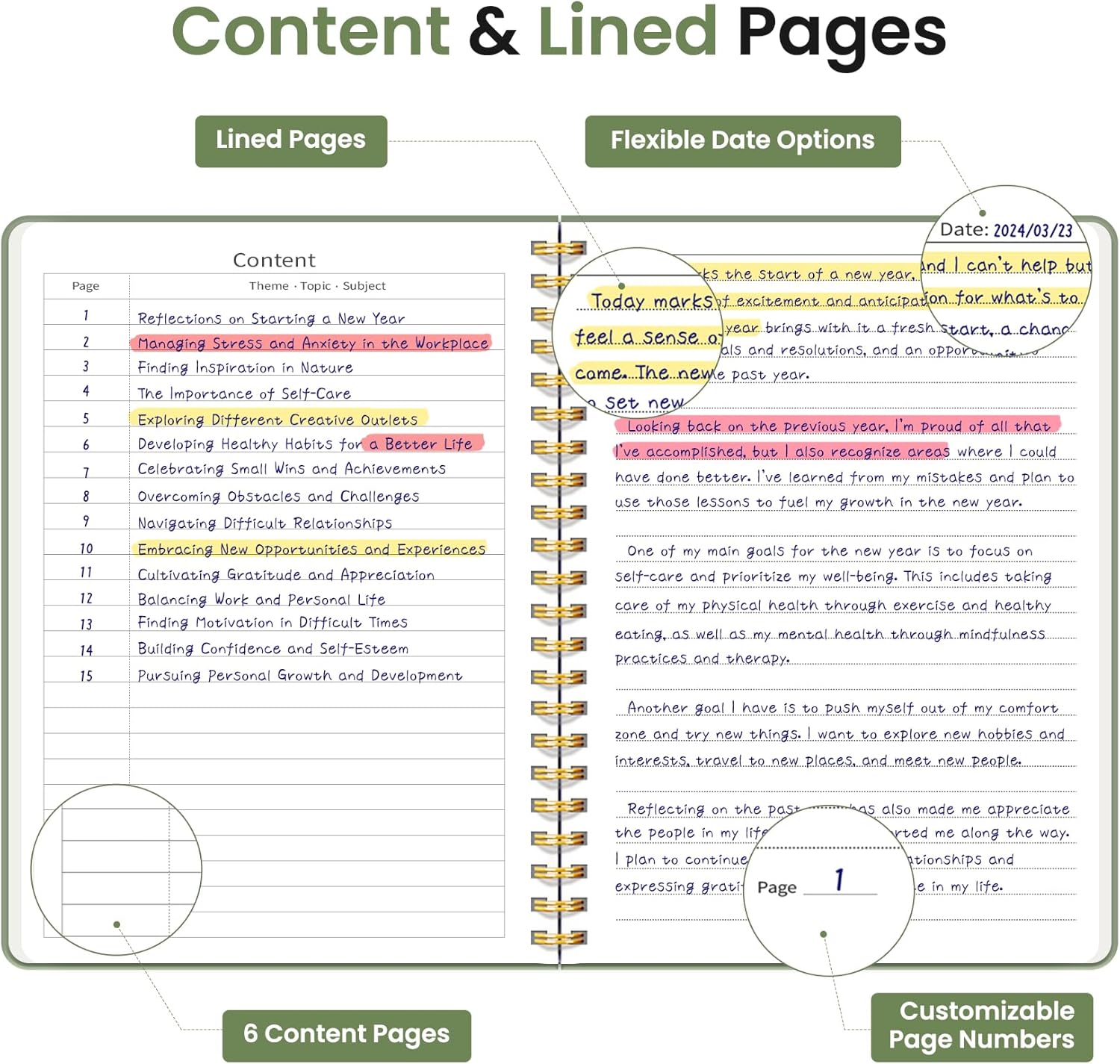
Lined Spiral Journal Notebook
A versatile format for lecture notes, daily planning, journaling, and project work. Look for perforated pages, a sturdy cover, and paper that suits the pens you use most.
- Lays fully flat or folds back on itself
- Lined pages suit everyday writing
- Easy to tear out a page cleanly
- Coil binding can catch inside a packed bag
- Use grid or dotted pages for layout-heavy work
Which notebook size is right for you?
A notebook that fits the routine gets used. Use this quick guide to choose the writing space and portability that make sense for you.
| Notebook size | Dimensions | Best for | Portability |
|---|---|---|---|
| A4 | 210 × 297 mm | Studio work and drafting | Desk-first |
| A5 | 148 × 210 mm | School, journaling, planning | Bag-friendly |
| A6 | 105 × 148 mm | Lists, travel, quick capture | Pocket-ready |
| B5 | 176 × 250 mm | Detailed study notes | Medium carry |

Find the right notebook for the task
For text-heavy notes, lined pages are a dependable default. Grid works well for planning and diagrams, while dotted and blank formats leave more room for creative layouts.
What to look for in a notebook
Start with the task
Text-heavy notes favor lined pages; diagrams and trackers favor grid; creative use often favors dots or blank pages.
Fit the daily carry
A5 balances writing room and portability. A6 works for quick capture. Choose A4 or B5 when the notebook stays at a desk.
Match the tools
Look for 80 gsm or heavier paper when you use gel pens, felt tips, or fountain pens and want less ghosting.
Ready to make note-taking easier?
See our top everyday notebook and check current retailer availability.
How we choose what to feature
We focus on the details that make a notebook genuinely useful: paper quality, page format, binding, durability, portability, and value. Affiliate links may earn us a commission when you buy, but they never determine the order of our recommendations.
Notebook FAQs
What is the difference between A5 and A6 notebooks?
An A5 notebook offers enough surface for full notes, journaling, and planning while still fitting most bags. An A6 notebook is a smaller, pocket-friendly format for lists, short entries, and quick ideas.
Are spiral notebooks better than composition notebooks?
Spiral notebooks lay flat, fold back, and often have perforated pages. Composition notebooks have sewn bindings that offer more page security. The better choice depends on whether flexibility or archival durability is more important.
What paper is best for bullet journaling?
A grid or dotted A5 notebook with paper around 90 gsm or heavier is a strong starting point. It gives enough structure for layouts while helping markers show through less.
How many pages should a student notebook have?
For a single subject, 80 to 120 pages is often enough. Multi-subject notebooks can carry 160 pages or more, especially when they include dividers and a durable cover.